
Is DecoratorAdvice.com Actually Helpful? A Deep Dive into This Home Décor Site
DecoratorAdvice.com sounds like the sort of place you stumble onto while searching “how to make my tiny living room look less tragic” and then realize you’ve just spent 45 minutes reading about paint undertones and sofa placement. It’s clearly built to do more than throw pretty pictures at the screen; the whole thing is arranged to talk a nervous, budget‑aware homeowner into actually doing something with their space.
So, what exactly is DecoratorAdvice.com?
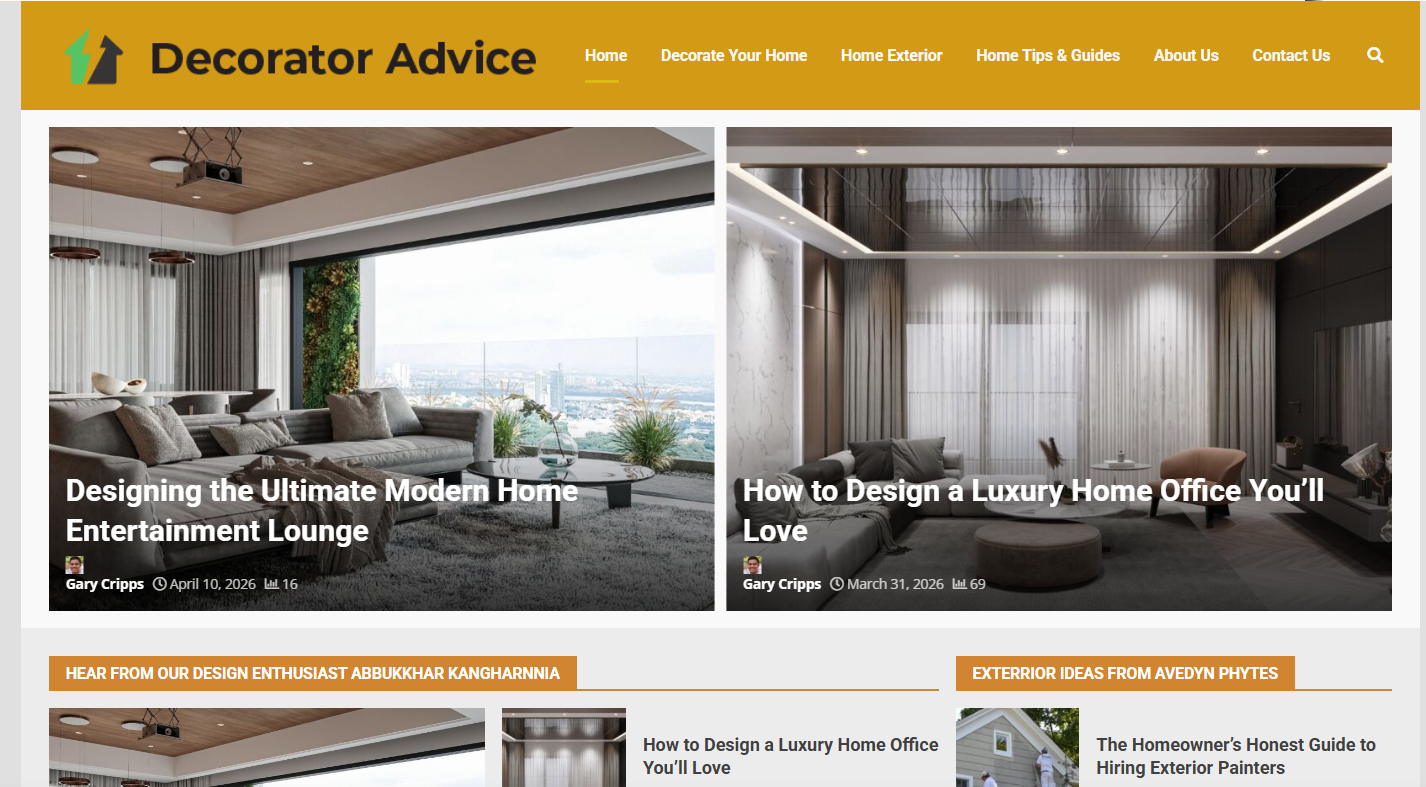
Think of DecoratorAdvice.com as a hybrid between a design magazine and a patient friend who has already made every decorating mistake you’re about to make. It’s a content‑first site: no e‑commerce storefront in your face, no “book a $500 consult” hard sell on every scroll. Instead, the front door opens into articles about how to transform a room, fix awkward layouts, or make an exterior look like someone cares who lives there.
The site introduces itself as a guide to home decorating, home design inspiration, and stylish living, but the tone is deliberately un‑intimidating. It talks like someone who has read the serious design books and then decided to translate them into normal language. Editorially, it promises “expert tips,” “creative ideas,” and “affordable solutions” rather than architectural manifestos, which is exactly where most readers actually live.
A lot of the content reads like this: here’s the problem, here’s why it happens, and here’s a way out that doesn’t involve knocking down a wall or buying a €3,000 armchair.
How the site is built from the inside out
This is not one of those chaotic blogs where yesterday’s “cozy kitchen” post is stacked on top of last year’s “garden hacks” with no organization. DecoratorAdvice.com is structured like someone thought very seriously about what a tired person might type into a search bar at midnight.
At the top level, there is a homepage that behaves like a lobby: a short introduction explaining what the site is, followed by doors into the big themes. Titles like “Transform Your Space with Expert Tips and Creative Ideas,” “Your Ultimate Guide for Home Decor Inspiration and Tips,” or “Expert Tips for Stylish Interior Design” act as mini‑portals into clusters of related guides.
Behind that, the content falls into a handful of intuitive buckets:
| Layer | What lives there |
| Home hub | Intro copy, featured guides, links into major topics and latest “expert tips.” |
| Core categories | Decorate Your Home, Home Exterior, Home Tips & Guides, DIY / Inspiration, Trends. |
| Themed hubs | “Transform Your Space”, “Maximize Your Space”, “Stylish Living”, “Home Decor Mastery.” |
| Individual articles | Room makeovers, layout walkthroughs, color guides, small‑space hacks, DIY projects. |
Content is arranged so that you can arrive through search on a single question (“small bedroom layout ideas”) and, without much thinking, find your way to a broader understanding of how to approach the whole room, then the whole home. It’s SEO‑savvy, yes, but it’s not hostile about it.
A walk through the main sections (as if you’re actually using them)
1. Inside the house: “Decorate Your Home”
Most people land here first, because this is where the interior questions are answered. This section is about real rooms with real awkward corners, not theoretical floor plans.
A typical article in this area will take one space, say the living room and break it into manageable problems: where the sofa should go, how big the rug needs to be, which wall gets the TV, how lighting should layer so the room doesn’t look like either a hospital or a cave. It will talk through choices rather than just showing a finished photo: why that layout works, what to copy, what to avoid.
The same logic shows up in bedroom pieces (storage vs. serenity), kitchen advice (zones, not chaos), and home‑office articles (how to be productive somewhere other than the dining table). The tone isn’t “thou shalt”; it’s “here’s what happens when you try this, and here’s a better way.”
2. Outside the front door: exteriors and curb appeal
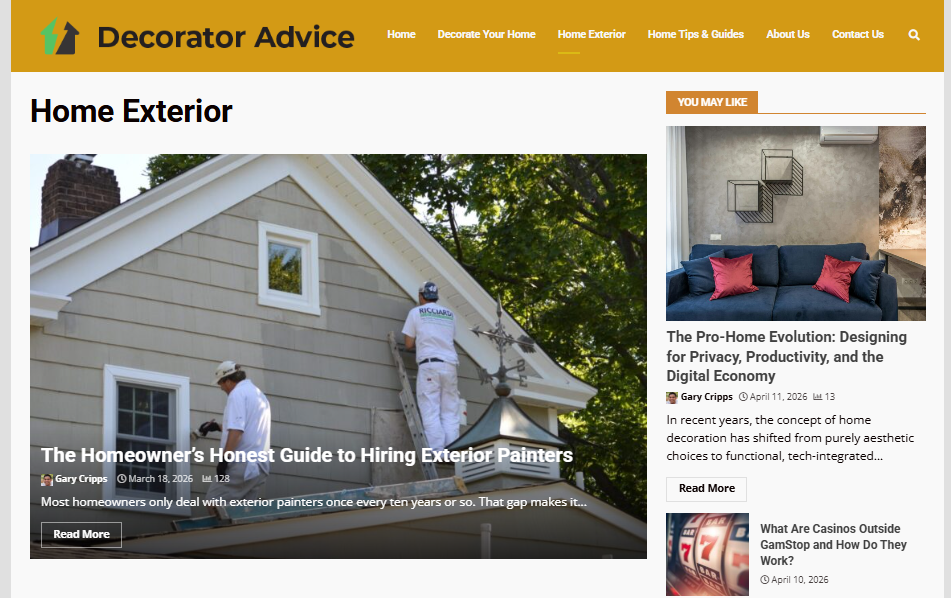
The exterior content feels like the part of the site that quietly saves neighbourhoods from looking sad. It’s about front doors, paths, porches, and façades that need more than a seasonal wreath.
Here the content leans toward:
● Curb appeal strategies: front door colors, house‑trim combinations, outdoor lighting for both security and mood.
● Outdoor styling: planters, seating, textiles, and small décor that make porches and patios feel welcoming rather than empty.
It’s not huge landscaping plans; it’s intelligent tweaks that matter.
3. The brain of the site: “Home Tips & Guides”
If the other sections are rooms, this one is the reference library. These pieces talk about the things that quietly make or break every space:
● spacing and scale
● focal points vs. visual noise
● how to mix styles without ending up with a theme park
● the dark art of choosing a paint colour that doesn’t turn weird at 4 p.m.
These articles tend to stay evergreen. They explain why some rooms feel balanced and others feel like furniture showrooms, and they do it without assuming readers have taken a design course. The DIY content lives here too: not “build your own extension,” but “yes, you can repaint that dresser,” or “this is how to style shelves without buying 27 new objects.”
Taken together, these sections behave like a system: inspiration (what could this room look like), strategy (why it works), and tactics (what to do tomorrow afternoon).
| Category | Typical article style | Overall feel from sampling |
| Decorate Your Home | Room guides, style breakdowns, layout recommendations | Practical, step‑by‑step, friendly |
| Home Exterior | Curb‑appeal and porch/entryway tips | Realistic, budget‑aware |
| Home Tips & Guides | Principles, checklists, DIY, small‑space/how‑to content | Educational, beginner‑friendly |
Reading experience: does it invite you in or push you out?
From a user’s seat, the biggest compliment you can give a site like this is: it stays out of the way. DecoratorAdvice.com largely does.
The typography is clean, the paragraphs are short without being chopped into fragments, and headings do the heavy lifting of signalling what’s coming next. Articles tend to be long enough to be useful but structured so they can be skimmed at speed exactly the mix you want when you’re reading on a phone while standing in the paint aisle.
The menus make sense; the search bar isn’t buried; the site doesn’t constantly drag you away from what you’re reading with aggressive pop‑ups. And when a piece ends, you get sensible suggestions for what to read next, not random content that happens to share a keyword.
If I had to score the experience in a way your readers can digest quickly, it would look like this:
| UX aspect | 1–5 score | Why it lands there |
| Navigation | 4.5 | Main themes are obvious; search and categories behave as expected. |
| Readability | 4.5 | Clear headings, conversational tone, not overloaded with bullet points. |
| Mobile experience | 4.0 | Responsive and comfortable for scrolling, with room for further refinement. |
| Content discovery | 4.0 | Related guides and hubs make it easy to keep exploring a topic. |
It feels like a site built by people who actually read on screens, not by a committee that only sees desktop wireframes.
Trust, honesty, and the fine print
Content about home design is full of taste and opinion, so trust always matters. DecoratorAdvice.com spends a lot of words explaining its intentions: human‑first writing, research‑backed ideas, regularly updated guides, suggestions based on quality and value rather than whoever shouted the loudest.
Names and “expert” descriptions appear on various about pages, along with promises of transparent editorial standards. That’s the self‑portrait. The more interesting part is what the outside world says.
Other home and décor sites describe DecoratorAdvice.com as a “must‑visit blog,” a “go‑to hub,” and a resource that helps readers avoid costly mistakes. It gets praise for being realistic and budget‑aware instead of chasing unattainable looks. Several reviewers talk about feeling more confident making decisions after reading its guides exactly the outcome a design educator wants.
On the more technical side, automatic trust and scam‑check tools are a little cooler in tone. One grades the site as highly trusted and secure. Another, using automated domain and category metrics, gives it a medium‑risk score in the high 50s out of 100 not a scam label, but a nudge to browse like a normal, cautious person on an ad‑supported site.
Put together, the trust picture looks like this:
| Dimension | What’s visible | Takeaway |
| Editorial intent | Human‑first, research‑backed, updated | Strong, user‑oriented framing |
| Real‑world feedback | Reviews praising practicality, clarity, budget focus | Very positive from actual readers |
| Technical trust scores | One high‑trust rating, one “medium‑risk” automated verdict | Broadly fine, with normal caution advised |
| Monetization | SEO‑driven structure, likely ads/affiliates, partner mentions | Standard modern content‑site model |
If your benchmark is, “Can I trust this for guidance, as long as I don’t treat it as the only voice in the room?” the answer is comfortably yes.
How much of this is SEO, and does that ruin it?
You can tell immediately that DecoratorAdvice.com is not an accident. Titles are structured around real queries people type. Article hubs read like intentional keyword clusters. The site architecture is exactly what an SEO consultant would sketch on a whiteboard.
The question is whether that makes the content feel hollow. Here, it mostly doesn’t. The SEO skeleton is there to hold up actual substance: detailed explanations, clear examples, and genuine attempts to solve readers’ problems, not just repeat the question back in slightly different wording.
A practical way to frame it for your readers:
| SEO factor | How it appears on the site | Reader impact |
| Keyworded titles | “Expert tips”, “maximize space”, “home decor inspiration” | You find what you’re actually looking for. |
| Topic clusters | Hubs around decorating, small spaces, DIY, stylish living | Easier to go deeper on a subject. |
| Internal linking | Guides pointing to related rooms/principles | Fewer dead ends, smoother reading journey. |
| Monetization hooks | Likely ads, affiliates, partner pages | Normal content‑site experience if used moderately |
It’s fair to call it an SEO‑driven website that remembers there are humans on the other side of the screen.
Who this site genuinely helps (and who will outgrow it)
DecoratorAdvice.com is built for people who are serious about how their home feels, but not trying to pass an interior‑design exam. It’s at its best when it’s talking to:
● first‑time homeowners who just realised empty rooms don’t magically style themselves
● renters trying to make a temporary space feel intentional
● chronic “I’ll fix this room someday” people who finally want a plan that doesn’t assume a luxury budget
For that crowd, the mix of inspiration, logic, and practical action steps is on point.
If someone is a professional designer, architect, or builder, the site becomes more of a light, client‑friendly reference than a technical resource. It is not where you go for structural calculations, high‑end custom millwork details, or trade‑only sourcing strategies. It also won’t satisfy readers who dislike SEO structure on principle people who only want print‑magazine essays or long‑form design books.
Final take: an expert’s look at a very human‑focused site
Seen through a decorator’s eyes, DecoratorAdvice.com is a well‑organized, opinionated companion rather than a glossy catalogue. It doesn’t try to be everything; it tries to be incredibly useful at the level where most decisions are made: how you place furniture, pick colours, juggle storage, and balance what you love with what you can afford.
Pulled together into a quick reference, its performance looks like this:
| Category | Score (1–5) | Expert‑style reading of what’s going on |
| Content quality | 4.0 | Strong for everyday homes; less deep for high‑end specialist work. |
| Practical usefulness | 4.5 | Plenty of ideas you can actually implement without a full reno. |
| Ease of use | 4.5 | Clear paths through the site; reader‑friendly structure. |
| Trust & transparency | 3.5 | Good intent and reception, with typical ad‑supported caveats. |
| Overall value | 4.0 | A dependable, user‑first home décor guide for most households. |
If a house is a long‑term project rather than a weekend makeover, DecoratorAdvice.com is the kind of tab that stays open in the browser: a place you return to whenever a new corner of the home starts asking for attention.
Post Comment
Recent Comments

Rose Bell
Apr 28, 2026This topic is trending right now, but most places are sharing incomplete info. I found a much more detailed and updated version on XenixNews ”






rose bell
May 4, 2026https://www.fashionbent.com/sakerplus-reviews-is-this-budget-tool-brand-legit-or-a-scam/