Charles Quincy Ascher Einstein: Tracing the Identity, Origins, and Historical Reality Behind the Name
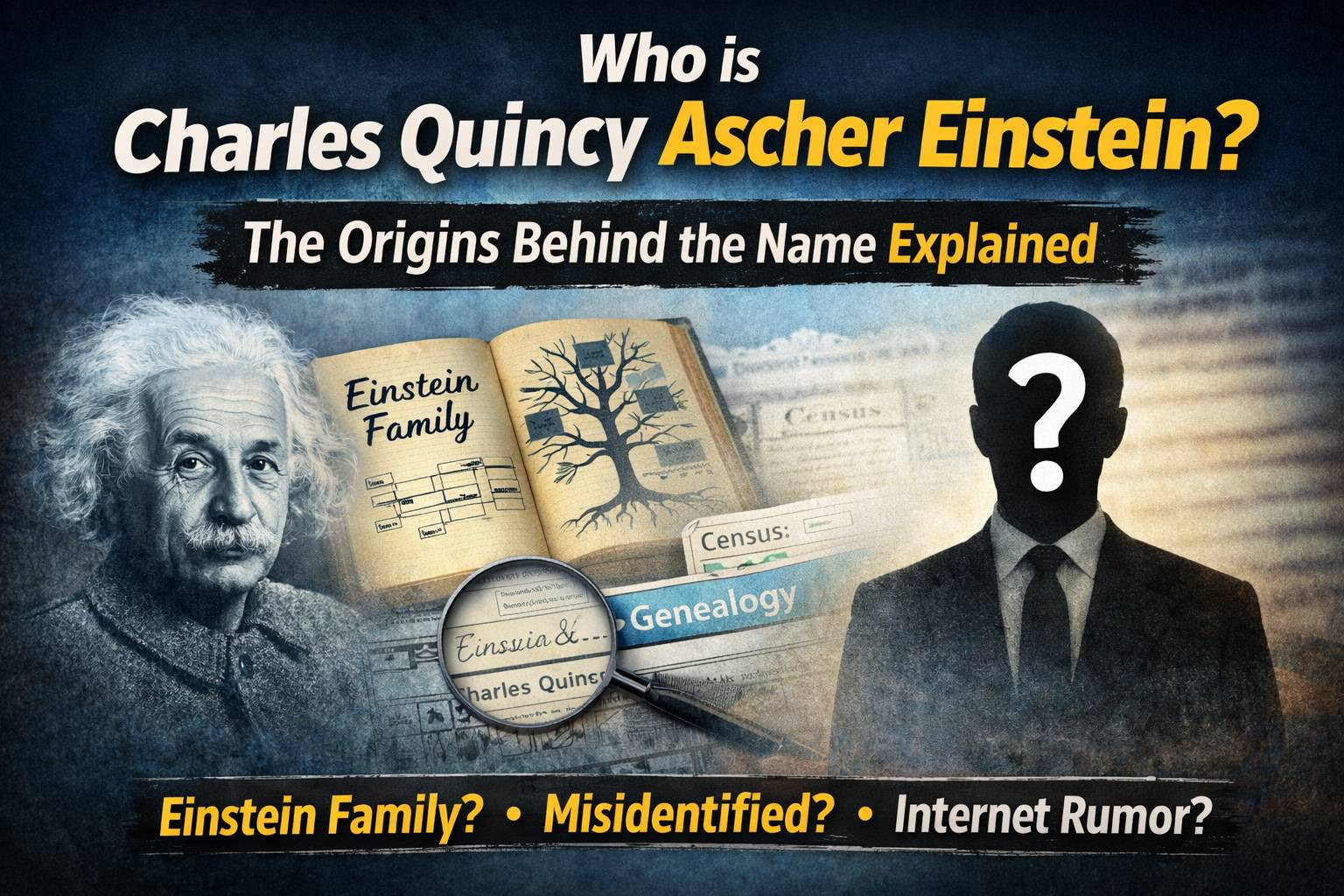
When a name includes “Einstein,” it immediately attracts attention. The surname carries enormous cultural weight, shaped almost entirely by one figure, Albert Einstein, whose legacy has grown far beyond science into popular culture, education, and internet mythology. Against that backdrop, the name Charles Quincy Ascher Einstein raises a natural question: is this an overlooked member of the Einstein family, a historical figure lost to time, or a modern misidentification amplified by the web?
Tracing the truth behind this name requires patience rather than excitement. The investigation is less about uncovering a hidden genius and more about understanding how names travel, how records fragment, and how assumptions fill the gaps.
What follows is not a dramatic reveal, but a measured examination of identity, documentation, and context.
How the name enters public curiosity
Unlike well documented historical figures, Charles Quincy Ascher Einstein does not appear in mainstream biographies, academic histories, or widely cited genealogical summaries of the Einstein family. The name tends to surface in three types of places:
1. Online discussions and genealogy forums
2. Aggregated profile websites with minimal sourcing
3. AI generated or auto populated name databases
This pattern matters. When a name appears primarily in derivative sources rather than primary records, it suggests that repetition may be creating perceived legitimacy.
The structure of the name itself also invites assumptions. “Charles” and “Quincy” reflect common Anglo American naming conventions, while “Ascher” resembles a known Einstein family surname variant. Combined with “Einstein,” the name sounds plausible enough to be accepted without verification.
Plausible, however, is not the same as proven.
What is known about the Einstein family structure
To understand whether the name fits historically, it helps to look briefly at what is firmly documented about the Einstein family.
Albert Einstein’s immediate family lineage is unusually well studied due to his global importance. His parents, siblings, wives, children, and grandchildren are extensively recorded in biographies, archival letters, immigration records, and academic studies.
Key confirmed points include:
1. The Einstein family originated in German speaking Jewish communities.
2. The surname “Einstein” was well established, but family branches were relatively traceable due to preserved records.
3. Middle names like “Ascher” do appear within extended Jewish family networks, sometimes as surnames, sometimes as patronymic references.
What does not appear in credible Einstein family trees is a clearly identified individual named Charles Quincy Ascher Einstein.
That absence does not automatically mean the person never existed. It does mean there is no verified connection to the famous Einstein lineage as commonly understood.
Examining the components of the name
Rather than treating the name as a single unit, it helps to examine its parts.
1. Charles- A widely used given name in English speaking countries, especially in the 19th and early 20th centuries.
2. Quincy- Often used as a middle name in American families, sometimes referencing family heritage or admired historical figures.
3. Ascher- This is the most interesting component. “Ascher” appears in Jewish surnames and given names, sometimes linked to the Hebrew name Asher. It also appears independently as a family name, unrelated to Einstein.
4. Einstein- A surname that existed long before Albert Einstein, but which is now overwhelmingly associated with him.
Individually, none of these elements are unusual. Together, they create an impression of historical depth, which may explain why the name circulates without scrutiny.
Where documentation becomes thin
A genuine historical figure usually leaves some footprint. This could include:
1. Census entries
2. Immigration records
3. Birth or death certificates
4. University enrollment records
5. Published work or professional listings
So far, no consistent set of primary documents has surfaced that confirms a single individual named Charles Quincy Ascher Einstein with verifiable dates, locations, and activities.
What does appear instead are scattered mentions that lack context, often without:
1. Birth year
2. Place of origin
3. Family connections
4. Occupation or public role
This pattern suggests one of three possibilities:
1. The name is a composite created from unrelated sources.
2. The individual existed but was recorded under a different name variation.
3. The name is a modern construct produced by database errors or automated content systems.
None of these scenarios point to a hidden member of the Einstein dynasty.
Why famous surnames attract invented identities
This case is not unique. Well known surnames routinely attract fictional or misattributed figures online.
There are clear reasons for this:
1. Search algorithms reward recognizable names.
2. Genealogy tools sometimes merge unrelated records.
3. AI systems generate plausible but unverified profiles.
4. Readers are less likely to question a familiar surname.
Once such a name appears in multiple places, it gains momentum. People cite each other, creating a loop where repetition replaces evidence.
Over time, the question shifts from “Is this real?” to “Why can’t I find more about them?” The assumption of existence goes unchallenged.
Comparing verified Einsteins and the disputed name
| Aspect | Verified Einstein Family Members | Charles Quincy Ascher Einstein |
| Primary records | Extensive and consistent | Largely absent |
| Family linkage | Clearly mapped | No confirmed link |
| Geographic trail | Germany, Switzerland, US | Unclear |
| Academic or public role | Documented | Undefined |
| Independent citations | Yes | Mostly derivative |
This comparison is not meant to dismiss the name outright, but to show how far it sits from established historical documentation.
Separating curiosity from confirmation
Curiosity is not a flaw. Many historical discoveries begin with a question. The issue emerges when curiosity skips the verification stage.
With Charles Quincy Ascher Einstein, curiosity has outpaced documentation. The name feels important, but importance has not been earned through evidence.
What reliable research confirms is limited:
1. The surname Einstein existed across multiple families.
2. The name Ascher appears independently in Jewish naming traditions.
3. No authoritative source connects this full name to the Einstein lineage of record.
What remains uncertain:
1. Whether the name refers to a real but undocumented individual.
2. Whether it originated from a transcription or data aggregation error.
3. Whether it was intentionally constructed for fictional or illustrative purposes.
Uncertainty, in this case, is not a failure of research. It is the honest result of following available evidence.
A measured understanding rather than a mystery
The truth behind Charles Quincy Ascher Einstein is not hidden behind locked archives or secret histories. It is more ordinary and more instructive than that.
This name illustrates how easily identity can be inferred rather than established, especially in the digital age. It shows how famous surnames distort perception and how absence of evidence is often mistaken for suppressed truth.
At present, the most responsible conclusion is simple:
There is no verified historical or genealogical evidence that Charles Quincy Ascher Einstein is a documented member of the Einstein family or a figure of historical significance connected to Albert Einstein. The name exists in circulation, but not in confirmed records.
That conclusion may feel anticlimactic. It is also accurate.
History advances not by filling gaps with imagination, but by acknowledging where the record ends.
Post Comment
Be the first to post comment!